Introduction
Mercury vapor poses significant health risks, and the Environmental Protection Agency (EPA) enforces stringent limits on mercury vapor levels: 1µg/m³ for residential areas and 25µg/m³ for industrial zones. Industrial hygienists, clean-up crews, and government agencies rely on portable instruments to monitor these levels. This document explores the various technologies available for detecting mercury vapor, including gold film sensors, atomic absorption spectroscopy, and atomic fluorescence spectroscopy, focusing on their mechanisms, interferences, and sensitivities.
Gold Film Sensor Technology
How it Works
Gold film sensors have been reliable mercury detectors due to gold’s natural affinity for mercury. AMETEK Brookfield capitalized on this by creating advanced mercury vapor analyzers. When mercury-laden air passes over a thin gold film, the mercury deposits on the gold, altering its electrical resistance. This change is proportional to the mercury mass in the air sample, measured in mg/m³. The instrument offers a ‘regeneration’ feature that heats the gold foil, vaporizing the mercury for collection. The diagram below shows how this works:

Interferences
An activated carbon filter, represented by the ‘green’ box in the schematic, removes hydrogen sulfide gas. Hydrogen sulfide, ammonia, and chlorine gas can react with the gold film, causing false positives. However, internal and external filters are available from AMETEK Brookfield to eliminate these interferences without affecting mercury concentration in samples.
Sensitivity
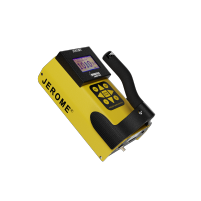
AMETEK Brookfield’s Jerome series has been manufacturing patented Gold Film Sensor mercury vapor analyzers for over 50 years, proving their effectiveness in diverse applications. The Jerome® J405, an advanced model, offers an on-board data logging system with a 20,000 data point storage capacity and an optional USB port. With a detection range of 0.5µg/m³ to 999µg/m³ and a resolution of 0.01µg/m³, the J405 meets both industrial and commercial mercury regulations.
Environments of Likely Interferences
Gold film sensors can be interfered with by hydrogen sulfide, ammonia, and chlorine. Internal and external filters help mitigate these interferences. However, in environments rich in both ammonia and chlorine, it can be challenging to measure mercury without interference. Additionally, gold film sensors require some oxygen to function, making them unsuitable for oxygen-devoid environments.
Atomic Absorption Spectroscopy
How it Works
Cold Vapor Atomic Absorption Spectroscopy (CVAAS) detects mercury by radiating a light source of known wavelength through an air sample. If mercury is present, its electrons absorb some of the light’s energy, and the energy difference measured by the detector indicates the mercury concentration. The Diagram below shows how this works.

Interferences
CVAAS can produce false positives as other substances can absorb the same wavelength. Interferences include chloride, sulfides, hydrocarbons, and organic solvents. The reflective mirrors in CVAAS units can also become soiled or dislodged.

Sensitivity
Portable CVAAS analyzers, such as the Nippon® EMP-3 and Lumex® 915 M, offer low-end sensitivities of 0.1µg/m³ and 0.002µg/m³, respectively. However, these instruments may detect other chemical species besides mercury, especially in contaminated environments.
Environments of Likely Interferences
CVAAS is suitable for environments with minimal interferences. However, in dusty or smoke-filled areas, such as old laboratories or hospitals being decommissioned, or in petroleum processing facilities with hydrocarbons, CVAAS may not provide reliable results.
Atomic Fluorescence Spectroscopy
How it Works
Cold Vapor Atomic Fluorescence Spectroscopy (CVAFS) improves upon CVAAS. When mercury absorbs UV light, it emits a photon of light upon returning to its ground state. CVAFS measures this fluorescence, which is unique to mercury and minimizes interferences. The diagram to the right shows how this works.

Interferences
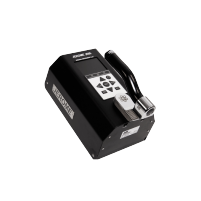
The J505 Atomic Fluorescence Spectroscopy Mercury Vapor Analyzer by AMETEK Brookfield only measures radial resonance fluorescence at 254nm, eliminating most interferences. The only reported positive interference is high acetone vapor concentration.
Sensitivity
The J505 detects mercury in the range of 0.05µg/m³ to 500µg/m³ with a resolution of 0.01µg/m³, meeting EPA, OSHA, and NIOSH standards. It stores up to 10,000 tests and features USB data download. Continuous sampling aids in locating contamination hotspots.
Environments of Likely Interferences
CVAFS is ideal for most environments, but in industries using large quantities of acetone, such as chemical processing or paint manufacturing, it might struggle to exclusively detect mercury vapor.
Conclusion
AMETEK Brookfield takes pride in its instruments and aims to educate customers on suitable mercury analysis technologies. Gold film sensors are reliable for various mercury detection levels, with manageable interferences. CVAAS is useful for ultra-low mercury analysis but faces significant interferences. CVAFS offers precise mercury detection with minimal interferences. Understanding each technology's behavior in specific applications is crucial for making informed decisions.
Appendix: Mercury Vapor and Human Health
Elemental mercury (Hg) is the only metal that remains liquid at room temperature, earning the nickname ‘quicksilver.’ Common in fluorescent lighting, antique switches, dental fillings, and thermometers, mercury can pose health risks if these items are damaged. Inhalation of mercury vapor is the most dangerous form of exposure, leading to symptoms like seizures, dementia, and death. Regulatory agencies have set varying exposure limits, with the EPA standard at 1µg/m³ for residential and 25µg/m³ for industrial properties.